Charlestowne Mall Redevelopment
 The Charlestowne Mall site has been the focus of extensive redevelopment discussions involving the City, the St. Charles community, the property’s ownership, and potential developers. Once a major retail destination, the mall faced significant tenant loss, and its interior permanently closed in 2017. Today, only Von Maur and Classic Cinemas remain open with exterior access. The majority of the property is owned by The Krausz Companies. While no plan has yet advanced, the City remains committed to ensuring future redevelopment balances market conditions with community goals and delivers long-term financial stability. The City will need to take a proactive role and will likely be required to provide financial support in order to attract development to the site. The purpose of this webpage is to outline the complex redevelopment challenges associated with the mall site, share the efforts being made by the City, and provide residents with status updates.
Additional Resources
Explain to me the Charlestowne Mall in 5 minutes - click here(PDF, 231KB)
Printer-friendly version of this webpage - click here(PDF, 2MB)
Recent podcast with Mayor and City staff - Youtube and Spotify
General Property Information
This section is designed to give the community a clear picture of the Charlestowne Mall property. It explains who currently owns the mall area, provides a description of the property itself, and outlines where things stand with its development status. It also looks back at the history of the mall, describing how it began, when it declined, and what past redevelopment plans have been discussed. Together, this background helps show why the site is such an important focus for the community today and what challenges and opportunities lie ahead for its future.
Ownership Status of the Mall Area
As is common with large mall properties, ownership of the Charlestowne Mall site can sometimes be confusing. The property has multiple tenants, spans several parcels, and has experienced ownership changes over time. Below is a description of the various ownership interests within the mall area, accompanied by a map for reference.
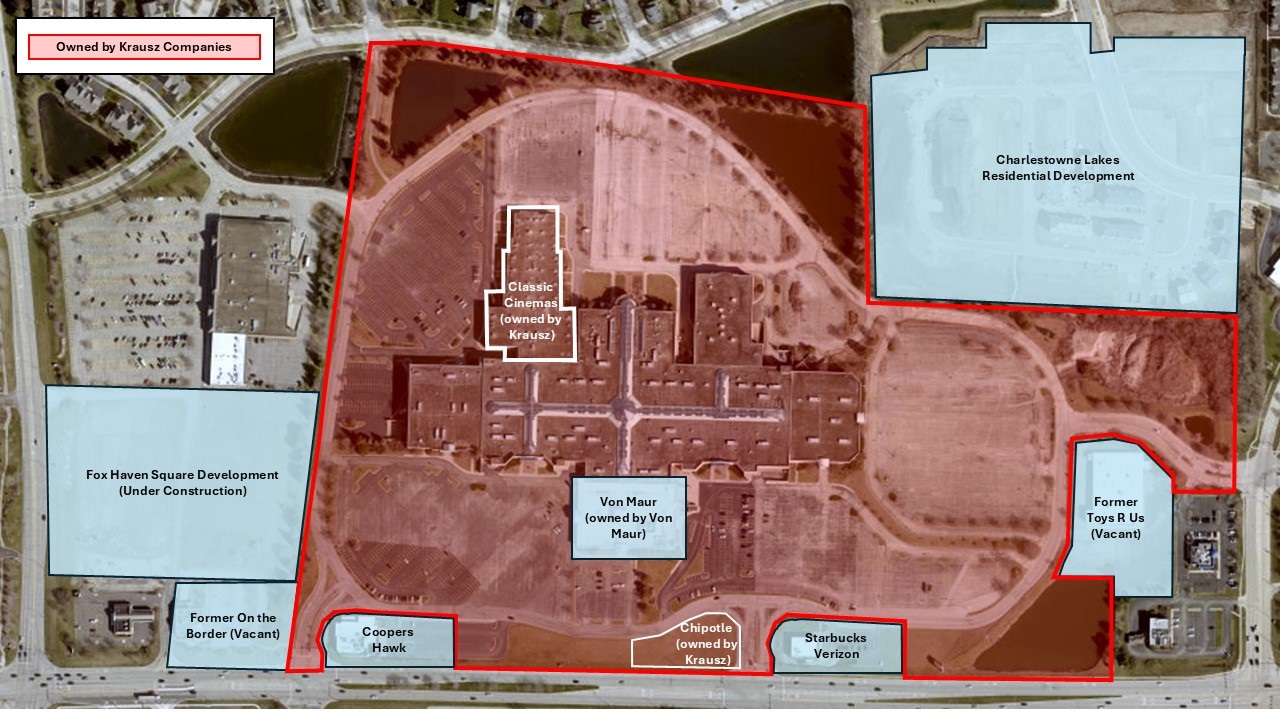
- Krausz Companies (or affiliate entities): A majority of Charlestowne Mall is owned by The Krausz Companies, a Las Vegas–based development firm. Their holdings include the central mall building along with the former Sears, Carson Pirie Scott, and Kohl’s department store spaces. They also own the Classic Cinemas theater building, which continues to operate, as well as several outlot properties including Cooper’s Hawk, the Starbucks/Verizon building, and Chipotle. See company website here.
- Von Maur: The only attached structure not owned by The Krausz Companies is the Von Maur, which owns its building independently. Von Maur also owns a section of the main mall structure that is incorporated into the interior of their store.
- Former Toys “R” Us: The former Toys "R" Us building is privately owned by a development company called Storebuilt. The building and property is listed for sale.
- City of St. Charles: The City of St. Charles does not own any portion of the Mall property.
Property Quick Facts
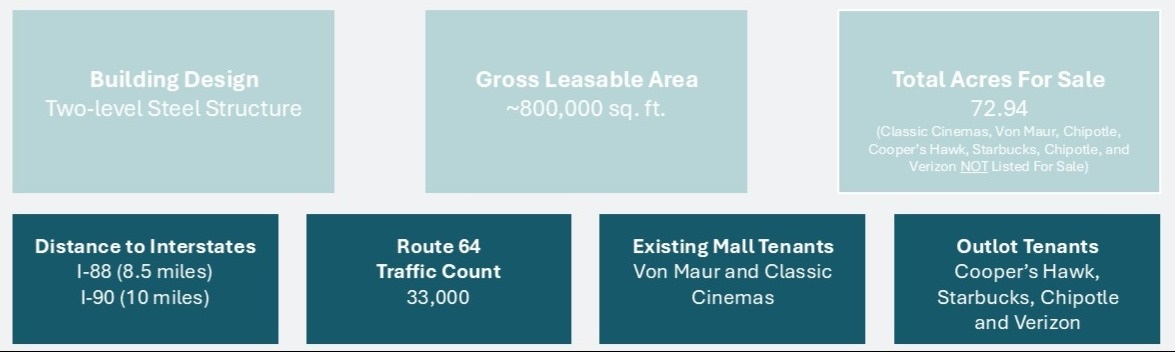
Built in 1991, Charlestowne Mall is a two-level steel structure with approximately 800,000 square feet of Gross Leasable Area on a 72.94-acre site that includes 7,173 parking spaces. Due to the site’s topography, the building has entrances on both the lower and upper levels, allowing access at multiple elevations throughout the structure. The property fronts East Main Street (IL Route 64) and has immediate access to Kirk Road and Smith Road. The mall is located two miles east of downtown St. Charles and 8.5 miles north of I-88 and 10 miles south of I-90. The site is anchored by Von Maur and Classic Cinemas, and the property with outlot tenants including Cooper’s Hawk, Starbucks, Chipotle, and Verizon. The other 3 former anchor tenant buildings and the interior mall are vacant.
History and Previous Plans for Redevelopment
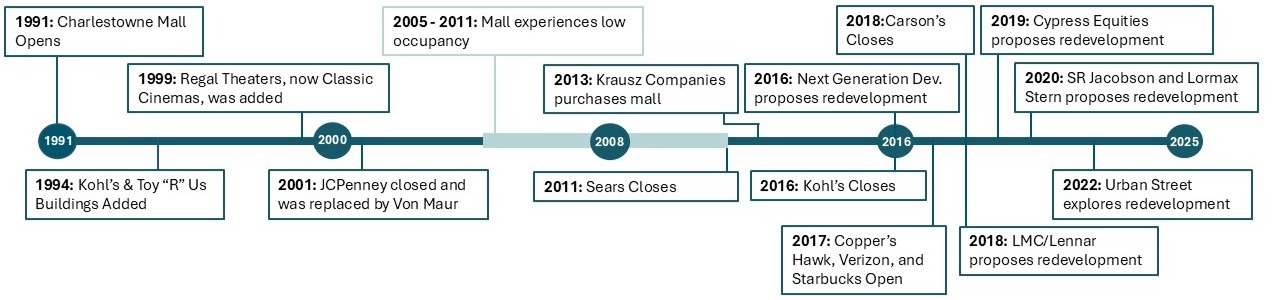
 Since opening in 1991, Charlestowne Mall has experienced periods of optimism, decline, and repeated redevelopment attempts. The timeline below highlights major milestones, from the mall’s original anchor tenants and expansions in the 1990s, to financial struggles and receivership in the 2000s, to failed redevelopment proposals in the 2010s and 2020s. These efforts reflect both the mall’s potential as a regional destination and the challenges of adapting to changing market conditions. Below is detailed information about the history of the mall and timeline chart.
Detailed Timeline
1991: Charlestowne Mall opens to the public in 1991, bringing 800,000 square feet of retail space to the area. Original anchors were Sears, JCPenney and Carson Pirie Scott.
1994: Kohl’s mall anchor store and freestanding Toys R Us store were added in 1994.
1999: Regal Theaters, now Classic Cinemas, was added.
2001: Anchor tenant JCPenney closed and was replaced by Von Maur.
2005-2011: The mall never experienced full occupancy during this era due to disproportionate square footage for the trade area, lack of substantial residential growth east of the mall, and competition from new commercial development along Randall Road. Charlestowne Mall went into receivership in 2005 until it was purchased by an overseas entity in 2010. Receivership is a legal process in which a court or lender appoints a neutral third party, called a receiver, to take control of a distressed property or business to preserve its value, manage operations, and protect the interests of creditors until the matter is resolved.
2011: Sears closed and many other stores left the mall around the same time.
2013: The Krausz Companies, the current owner, purchased the mall with the intent to renovate the existing mall to provide an enhanced retail and entertainment destination called The Quad St. Charles.
2016: Anchor tenant Kohl's closed. Krausz Companies later purchased the vacant building. Next Generation Development proposed a Concept Plan to retain 150,000 square feet of retail space and adding 256 rental apartments and 155 townhomes. The Concept Plan fell through due to lack of interest from retail tenants and insufficient lease rates. The developer then proposed another plan that called for partial demolition of the mall, retaining Von Maur and the Cinemas, and adding 185,000 square feet of retail and restaurant uses, 184 apartments, and 156 townhomes; however, this plan also fell through due to an unpredictable real estate market and the proposed pay as you go TIF funding.
2017: Five new outlots around the mall property were added, including Cooper’s Hawk, Verizon and Starbucks.
2018: Anchor tenant Carson's closed and the remainder of the mall was closed at this point. LMC/Lennar proposed a redevelopment plan to demolish the mall, retaining Von Maur and the Cinemas, and adding additional retail space, apartments, and townhomes. After working with the City, consultants, and engineering teams, Lennar withdrew from the project, citing financial challenges and an inability to achieve sufficient market returns.
2019: Cypress Equities expressed interest in developing the retail portion of the site with townhome parcels to be sold to a residential developer. Cypress intended to bring a Lifetime Fitness to the area as part of the redevelopment; however, the COVID-19 pandemic emerged at the time plans were progressing, and the opportunity was stifled.
2020: The Krausz Companies engaged with SR Jacobson and Lormax Stern to be the primary developer for the site. A Concept Plan was submitted in 2021 and called for 324 apartments, 208 rental townhomes, a 135-room hotel, and 40,700 square feet of retail space. Due to opposition, the team revised plans to redesign the commercial area to include more recreational space, relocate the hotel, and reduce the density of townhomes. Due to lack of support from the City, SR Jacobson and Lormax Stern withdrew from the project
2022: The site was under contract with Urban Street Group, but after a year of due diligence, the developer ultimately withdrew due to financial concerns with the project.
2025: Chipotle relocates from across Route 64. Krausz Companies officially lists the mall property for sale.
Timeline Chart of Charlestowne Mall
Redevelopment Information
Redeveloping a property as large and complex as Charlestowne Mall takes time and careful planning. This section explains how the City’s approval process works and what timeline a redevelopment project would likely follow. It also highlights the major challenges developers face. In addition, this section provides trade area data that compares Charlestowne Mall with other regional malls, helping to explain how market conditions affect redevelopment options. Other important considerations—such as community impacts, involvement of the school and park districts, and other long-term planning goals need to be addressed.
Development Status
Krausz Companies has been working with the Mayor and City staff on the future of the Charlestowne Mall site to help identify a developer with the financial capacity and expertise needed to successfully redevelop the property. To advance this effort, Krausz has retained Frontline Real Estate Partners to officially list and market the site. The marketing materials can be found here: Broker Brochure(PDF, 9MB)
To support prospective developers and streamline their due diligence, Krausz Companies has undertaken a series of analysis efforts. While some of this work is still ongoing, the information will be valuable to both developers and the City when designing and reviewing redevelopment proposals. By completing this work upfront, Krausz aims to reduce the time and costs typically required for developers to evaluate the site, making it easier to assess potential redevelopment opportunities.
Property Owner Site Analyses
Property Engineering Analysis
This includes evaluating existing engineering conditions and identifying future critical infrastructure requirements necessary to support the site’s development. Key improvements required for redevelopment will involve upgrades to internal roadways, water and sewer systems, electrical service, stormwater management, and site grading. A comprehensive understanding of the current utilities and their complexity is essential, as these factors will directly inform the site plan layout, land-use mix, redevelopment costs, and overall financial feasibility.
Project Costs Summary
Multiple developers have concluded that reuse of the main mall structure is not feasible from a market perspective, and that modifications would be equally challenging from a construction standpoint. The project cost summary evaluates the scope, sequencing, and expenses associated with removing existing structures and preparing the site for redevelopment. This includes demolition, building façade replacement (for the Theater and Von Maur walls that connect to the existing mall), earthwork, pavement removal, and retaining wall modifications. It also accounts for the cost of upgrading and relocating utilities such as stormwater systems, sanitary sewer, water mains, gas, and electrical infrastructure.
Housing Market Study
The objective of this study is to compile and evaluate pertinent housing information in order to provide product, pricing and absorption projections for the recommended product type should a developer pursue a portion of the property for residential development. Click here(PDF, 3MB) to view Housing Study completed by the property owner.
Approval Process and Timing
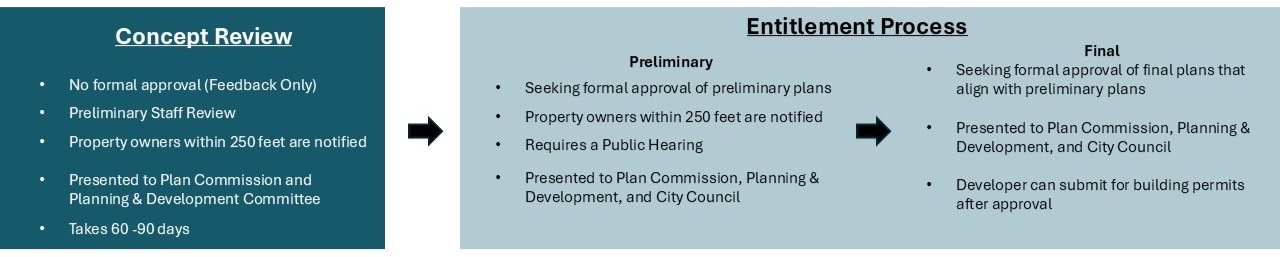
Redeveloping Charlestowne Mall requires several layers of review by the City. Developers first present a concept plan to gather feedback, then submit detailed documents during the entitlement process for formal approval. These steps ensure residents, the school district, and park district can weigh in while the City carefully reviews design, infrastructure, and community impacts. Given the site’s size, the approval process often spans many months and includes multiple public meetings. Below is a detailed explanation of each part of the approval process and a chart showing the steps of approval. The City’s approval process brochure can be reviewed here.
Concept Review Process
Any redevelopment proposal for the Charlestowne Mall site will begin with a Concept Plan application. This initial review process provides developers the opportunity to receive informal feedback from City officials and the public before investing in detailed design and engineering work. As part of the Concept Plan application, the developer submits general project information along with a site plan and sample building elevations. These materials are presented to the Plan Commission and the Planning & Development Committee for discussion. The Concept Plan review does not result in a final decision by the City; instead, it provides the developer with valuable input to determine whether to move the project forward. In addition, the School District and Park District receive the information prior to the public presentation, and all property owners within 250 feet of the site are notified of the application. The Concept Plan review process typically takes 60-90 days. Developers may return to the Commission and Committee multiple times if they wish to seek further feedback.
Entitlement Review Process
If a developer chooses to proceed, the project enters the formal entitlement process. At this stage, the developer must provide detailed engineering and site plan documents for an in-depth review by City staff. These materials are evaluated as part of the process for formal City approval. A public hearing will be required and all property owners within 250 feet of the site are notified of the time and place. The hearing is held at a Plan Commission meeting where the Commission hears the developer’s presentation, takes public comment and may request that the developer return with additional information. After the public hearing, commissioners review and discuss the proposal. The Commission will deliberate regarding how the project meets review criteria in the City Code and the City’s Comprehensive Plan. The Plan Commission will then issue a formal recommendation to the City Council for approval, approval with conditions, or denial. Once the Plan Commission has acted, the proposal moves to the Planning and Development Committee, where the developer presents again. The Committee considers the recommendations of the Plan Commission and then makes its own recommendation to advance the project for City Council consideration. The City Council has the final authority to approve or deny the project. The Entitlement approval process for a project of this scale typically takes 6 to 10 months.
Expected Approval Timing for Charlestowne Mall
Any redevelopment proposal for the Charlestowne Mall will be required to go through both the Concept Review process and the formal entitlement process. Given the size and complexity of the site, the approval process is expected to take longer than normal developments and will include several public meetings for discussion and formal action. It is important to note that there will likely be a gap of 4–6 months between the Concept Review and the Entitlement process. This timeframe allows the developer to design and prepare the necessary engineering documents. From the start of the Concept Review to final City Council approval, the entire process could take anywhere from 8-12 months.
Approval Process Breakdown Chart
Challenges to Development
Redeveloping the Charlestowne Mall site presents a number of significant hurdles. Any successful plan must resolve these issues before the property can be transformed into a pad ready site, meaning land that has been cleared, graded, and equipped with essential utilities and access so that construction can begin immediately. The complexity and cost of achieving this condition make it difficult to identify a redevelopment approach that is both practical, financially feasible and will have community support. Estimates provided to the City indicate that transforming the site to pad ready could cost $30 million or more in infrastructure costs. Due to the project's complexity, there is expected to be a significant amount of soft costs with the project including legal, engineering and design work. This places a major challenge on potential developers to find ways to minimize costs without compromising design quality or construction standards. The challenges outlined below provide a summary of the key issues and estimated costs. It should be noted that these figures are estimates only; actual costs could vary depending on the specific redevelopment design, market conditions, and fluctuations in material and labor expenses. These costs don't include new construction.
Reuse of the Existing Mall Structure
The traditional enclosed mall model was built around large department store anchors and a steady stream of national retail tenants. Over the past two decades, however, consumer shopping habits have shifted dramatically toward online retail. This shift has reduced both foot traffic and tenant demand for traditional mall space. Most major department store chains that once anchored malls such as Sears, JCPenney, and Carson’s have closed or downsized significantly. Without these anchors to drive traffic, smaller retailers struggle to remain viable, leaving large portions of mall space vacant. Developers face difficulty attracting new tenants because national retailers increasingly prefer smaller, flexible footprints in walkable, mixed-use settings rather than in large, enclosed malls. Additionally, entertainment, dining, and service-oriented uses which represent growing segments of consumer spending require very different layouts than the mall’s original design. The mismatch between what the market demands today and what traditional malls can offer makes reusing them in their current form economically unfeasible. A partial demolition of Charlestowne Mall has been explored in the past; however, the mall’s construction design makes this option both difficult and costly. Even with selective demolition, a large portion of the building would remain, leaving behind a layout that does not align with today’s business needs. The remaining structure would require highly specialized or unconventional uses, making it challenging to attract financially viable tenants or adapt the space to modern market demands.
Demolition Costs and Continuing Operations for Existing Tenants
The latest estimate for demolishing the Charlestowne Mall structure, excluding Von Maur and Classic Cinemas, is approximately $8.6 million. This figure reflects demolition costs only. However, removing the mall will also require additional work to ensure the site remains safe and functional.
The mall currently has two major tenants, Classic Cinemas and Von Maur, that remain connected to the structure, as well as several outlot tenants including Cooper’s Hawk, Chipotle, and the Starbucks/Verizon building. These ongoing operations make construction and demolition particularly challenging.
-
The developer must ensure that all utility services to these tenants remain functional while being removed and relocated. This may require temporary service shutoffs or the installation of alternative temporary utility connections.
-
Construction activities must be carefully managed to minimize disruption from issues such as parking limitations, noise, and dust, all of which could affect the daily operations of these businesses.
Rebuilding Facades for Existing Tenants
Demolition of the mall would require construction of new facades for both Classic Cinemas and Von Maur. The estimated cost for these improvements is between $2.6 and $3 million. The expense is significant not only because of the large surface areas that must be replaced, but also due to the complexity of Von Maur’s design. Unlike Classic Cinemas, the Von Maur store is structurally integrated into the mall, meaning that its rear façade cannot simply be patched. Instead, it must be fully redesigned from an engineering standpoint to create a functional and visually appealing exterior once the mall structure is removed.

Site topography, Grading and Earthwork
One of the unique characteristics of the Charlestowne Mall site is its varied topography. When the mall was constructed, the grading was designed to allow entrances on both the lower and upper levels of the mall and anchor stores. The result is a property with a wide range of elevations, including both steep drops and gently sloped areas, all of which present challenges for redevelopment. Below is a list of those challenges, along with topographic information and elevation photos. The topographic map shown here has been simplified to more clearly illustrate the elevation changes. For a more detailed version of the topographic map, click here.
- The dramatic grade changes across the Charlestowne Mall site create significant challenges for redevelopment. From a land planning perspective, the elevation shifts make it difficult to design a cohesive development with strong internal connectivity. Commercial users, in particular, value visibility and accessibility from Route 64, which becomes harder to achieve on a site with such varied topography.
-
Maintaining access to the existing businesses requires maintaining some of the grade transitions. Von Maur, at the front of the site, is accessed from both the upper and lower levels, while Classic Cinemas, located behind the mall, is on the lower level.
-
Efforts to regrade the property to create smoother, more uniform development areas would also expose existing utilities. Relocating these utilities would add substantial costs to the project and could negatively impact overall financial feasibility.
-
Redevelopment plans will likely require the construction of retaining walls in areas where the site’s steep elevation changes make grading alone insufficient. These walls are necessary to stabilize the site and create level building pads and roadways. Preliminary estimates suggest that retaining walls could add as much as $700,000 to the overall project cost.

Elevation Photos

Relocation and Upsizing of Utilities
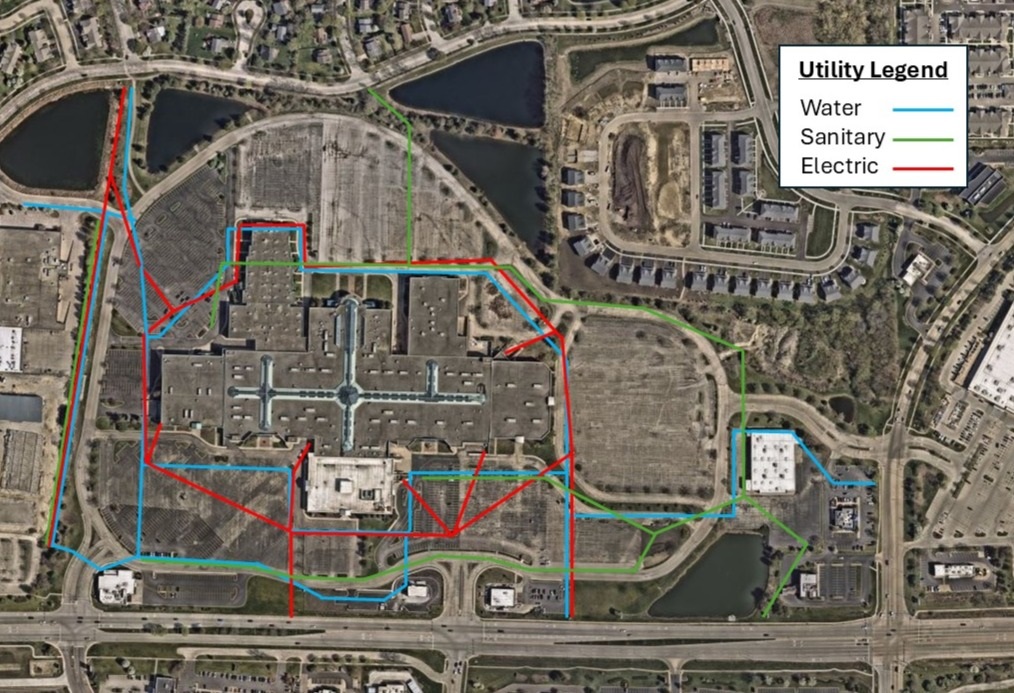
The existing utilities on the site, including water, sanitary sewer, electric, and storm water, were originally installed to serve the mall, which was a unique large-scale structure. Many of these lines wrap around the building and are built into the grading. Redevelopment of the property will require relocating many of these utilities to properly serve new buildings and site layouts. Depending on the future land uses, some utilities may also need to be upsized to handle increased demand, adding further complexity and cost. The combined cost of rerouting and upgrading utility infrastructure has been estimated at more than $10 million, representing one of the most significant financial considerations for redevelopment of the site. Previous developers have attempted to reduce the costs of relocating utilities by designing redevelopment plans that positioned some buildings around the existing lines. However, this approach can only achieve so much and often results in a site plan that is less than ideal from a land-planning perspective.
Stormwater Detention Improvements
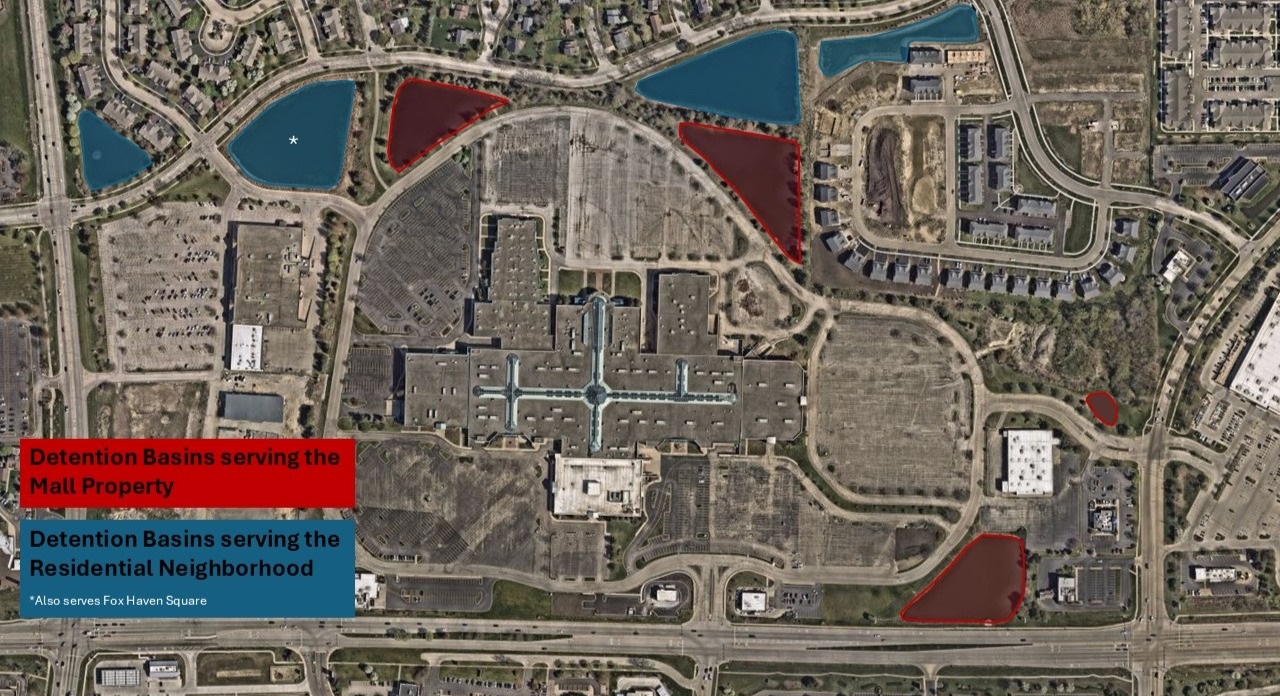
The mall property contains three large and 1 small detention ponds originally constructed to serve the site; these ponds do not serve any of the surrounding residential properties. Since the mall’s construction, Kane County stormwater regulations have been updated, and the existing ponds no longer meet current standards. Any redevelopment would require a thorough assessment and necessary upgrades to bring the detention facilities into compliance. Developers could also mitigate stormwater issues by reducing paved surfaces and incorporating additional green space. While the specific improvements and costs have not yet been determined, this is a significant factor that a prospective developer will need to address early in the planning process.
Existing Tenants Legal Rights
When malls were originally developed, they often involved multiple property owners and businesses within a single project. To coordinate these separate entities, a Construction, Operation, and Reciprocal Easement Agreement (COREA) was established. A COREA is a legal document that defines the rights and responsibilities of all property owners and businesses on a shared site, typically addressing matters such as construction standards, shared access and parking, utilities, signage, maintenance obligations, operating covenants, use restrictions, and dispute resolution. When a developer purchases a mall property, they inherit the existing COREA and must comply with its terms. In the case of Charlestowne Mall, the COREA includes detailed provisions, which grants the anchor businesses rights to influence the development to protect their business operations. One of the most significant aspects is the requirement to maintain a specific number of parking spaces for existing tenants. As a result, any redevelopment scenario for the site must incorporate sufficient dedicated parking spaces for the businesses to remain in compliance with the COREA.
Interest and Financing Costs
In recent years, financing the redevelopment of large properties such as malls has become increasingly difficult due to higher interest rates. Commercial real estate loans that once carried favorable rates now often fall in the range of 6 to 12 percent, which significantly increases borrowing costs and reduces potential returns for developers. Lenders have also adopted stricter standards, requiring higher debt service coverage ratios and lower loan-to-value ratios. This makes it harder for developers to qualify for financing on projects that already carry substantial upfront costs, such as demolition, utility relocation, and infrastructure upgrades. In addition, many commercial mortgages across the country are coming due, forcing property owners to refinance at today’s higher rates. This refinancing challenge has created further pressure on lenders and developers, reducing the availability of capital for new projects. Altogether, the combination of elevated borrowing costs, tighter lending requirements, and refinancing risks has made financing a redevelopment of the Charlestowne Mall site especially difficult in the current market. This was a major reason why the previous development group withdrew its proposal, as interest rates were rising while they were still exploring the project.
No Interstate Access
Direct access to an interstate is a major advantage for shopping centers, since it expands the customer base, increases visibility, and makes the site easier to reach for both local and regional visitors. Many successful malls in the Chicago region benefit from this connectivity—eight have immediate access to one interstate, and four have direct access to two.
Charlestowne Mall, however, does not have immediate interstate access. While it is well positioned along Route 64 with strong traffic counts, the lack of nearby interstate connections limits its regional draw compared to other malls across Chicagoland. This has been a key factor in the mall’s long-term challenges and redevelopment outlook.
New Internal Roadway Network
Redevelopment of the Charlestowne Mall will require replacing the outdated ring road system with a new internal road network to improve access, circulation, and site connectivity. The cost of constructing the new roadway system is significant.
Trade Market Area
Commercial businesses such as retail stores, restaurants, and entertainment venues depend on a strong local population to generate steady sales and foot traffic. The more households that surround a shopping center, the greater the built-in customer base to support those businesses and the more attractive the redevelopment is for a developer. For Charlestowne Mall, the surrounding area has relatively low population density compared to other successful shopping corridors in the region. With fewer nearby residents, there is less day-to-day demand to sustain large-scale retail, making it harder to attract and retain major tenants. The graphic below provides the basic demographic and market data within a five-mile radius of the Charlestowne Mall site. Developers and businesses rely on this data to evaluate the market feasibility of proposed commercial uses and to understand the strength of the local customer base.

2024 Five-Mile Trade Area Data
The chart below highlights existing and some vacant malls or regional shopping centers, comparing their five-mile trade area demographics. It shows differences in both population and median household income and is ranked from lowest to highest by population. More detailed reports for each center can be accessed by clicking the corresponding data report link. For a basic narrative of the status of other Chicagoland Malls view the link here(PDF, 75KB) .
| Mall Name |
Status |
Population |
Median Household Income |
Interstate
Access
|
Data Reports |
| Charlestowne Mall |
Closed - except the Von Maur and Classic Cinemas |
107,893 |
$124,039 |
No |
Data Report(PDF, 140KB) |
| Gurnee Mills Mall |
Open |
118,579 |
$106,538 |
Yes |
Data Report(PDF, 140KB) |
| Hawthorn Center Mall |
Open - Undergoing phased redevelopment |
129,864 |
$146,910 |
Yes |
Data Report(PDF, 140KB) |
| Spring Hill Mall |
Demolished - Purchased and demolish by Village. No redevelopment plans. |
148,041 |
$97,303 |
Yes |
Data Report(PDF, 140KB) |
| Northbrook Court Mall |
Open - Plans to redeveloped with heavy residential. |
154,160 |
$154,525 |
Yes |
Data Report(PDF, 140KB) |
| Arboretum of South Barrington |
Open |
154,843 |
$103,692 |
Yes |
Data Report(PDF, 140KB) |
| Orland Square Mall |
Open - Undergoing redevelopment of former Sears to Dick's House of Sport. |
161,045 |
$107,865 |
No |
Data Report(PDF, 140KB) |
| Burr Ridge Village Center |
Open |
184,846 |
$114,142 |
Yes |
Data Report(PDF, 140KB) |
| Louis-Joliet Mall |
Open - Large vacancies but no public redevelopment plans. |
188,567 |
$100,424 |
Yes |
Data Report(PDF, 140KB) |
| Promenade of Boilingbrook |
Open |
203,615 |
$108,097 |
Yes |
Data Report(PDF, 140KB) |
| Aurora Premium Outlet |
Open |
211,639 |
$96,481 |
Yes |
Data Report(PDF, 140KB) |
| Stratford Square |
Demolished - Purchased by village and demolished for $20 million. No redevelopment plans. |
250,192 |
$108,079 |
No |
Data Report(PDF, 140KB) |
| Woodfield Mall |
Open |
259,926 |
$105,342 |
Yes |
Data Report(PDF, 140KB) |
| Fox Valley Mall |
Open - Undergoing phased redevelopment with heavy residential |
260,283 |
$120,764 |
No |
Data Report(PDF, 140KB) |
| Yorktown Mall |
Open - Undergoing phased redevelopment with residential. |
262,824 |
$116,036 |
Yes |
Data Report(PDF, 140KB) |
| Oakbrook Mall |
Open |
289,416 |
$113,442 |
Yes |
Data Report(PDF, 140KB) |
| Randhurst Village |
Open |
320,983 |
$101,422 |
No |
Data Report(PDF, 140KB) |
| Old Orchard |
Open - Proposed redevelopment with residential. |
381,951 |
$110,052 |
No |
Data Report(PDF, 140KB) |
Other Considerations
City’s Eastside Sanitary Sewer Trunk Main Expansion
The east side of St. Charles is served by a sewer trunk main line that extends from the far east side of the City to the Main Treatment Plant on South 7th Avenue. To continue supporting existing development and to accommodate future growth, this trunk main must be expanded. Although construction on the expansion has already begun, much of the work remains unfinished and completion is not expected until at least 2030. The estimated cost of the project exceeds $40 million. As redevelopment of the Charlestowne Mall site is considered, the City must carefully weigh the impacts of phasing and build-out timelines to ensure adequate capacity. This requires coordinated planning, programming, and budgeting for improvements across the broader utility network so that infrastructure needs are met when growth occurs.
Site Residential Density
Many vacant or struggling malls across the region are being redeveloped with denser residential uses, often combining apartments and townhomes. Examples include Fox Valley Mall, Yorktown Center, and Hawthorn Mall. Past proposals for Charlestowne Mall have followed this same pattern, calling for demolition of the existing mall and replacing it with new housing and supporting commercial space.
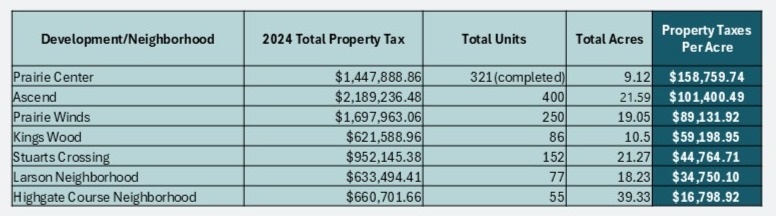
One of the main reasons developers pursue higher density housing is the financial impact. A dense residential development generates significantly more property tax revenue than a less dense residential project or a purely commercial redevelopment. The City’s goal is to support a project that can financially sustain itself, with the taxes generated on-site helping offset the very high costs of demolition and site preparation. The higher the property tax revenue from redevelopment, the less the City will need to draw on financial resources from other areas.
Below is a real world example of this in St. Charles. The analysis shows a variety of different residential development and commercial properties and how much those developments generate in property taxes per acre. The analysis shows the denser the development the more property tax revenue is generated and to what degree.
Other miscellaneous points to note:
- The size and density of a development are major factors in determining property tax revenue however other important factors include the quality of housing product, design, and location.
- Commercial properties may also generate sales tax, but that depends on the specific uses and their performance.
- Even if a residential project is dense enough to offset redevelopment costs through taxes, it must still align with market demand for that housing type. Without demand, the project will not succeed financially.
When it comes to land use at the Charlestowne Mall site, the challenge is finding a redevelopment plan that generates enough revenue to offset the high costs of site preparation while still meeting sound urban planning and design standards.

Financial Assistance from City
Redeveloping the Charlestowne Mall will almost certainly require financial assistance from the City due to the unusually high costs of demolition, infrastructure improvements, and other development expenses. Without support, these extraordinary costs make most redevelopment proposals financially unfeasible. The City is open to considering a variety of incentive tools, but two approaches previously discussed are Tax Increment Financing (TIF) and Sales Tax Rebates.
A TIF District works by freezing the property’s current taxable value. As redevelopment occurs and property values within the district increase, the additional property tax revenue called the “increment” is set aside by the City to reimburse eligible redevelopment costs such as demolition, utility upgrades, or site preparation. In this way, the project helps fund itself over time. Learn more about City TIF Districts here.
Sales Tax Rebates are another tool in which a portion of new sales tax revenue generated by businesses on the redeveloped site is returned to the developer for a set period. These rebates help offset upfront costs while ensuring that the City and community benefit from increased economic activity. Learn more about Sales Tax Rebates here.
School and Park District Impact
Redevelopment of the Charlestowne Mall site must take into account the needs of both School District 303 and the St. Charles Park District. The City partners closely with these taxing bodies on all development projects to ensure that community services and facilities are properly supported. It is anticipated that any redevelopment plan will include the dedication of a public park site, creating new recreational opportunities for residents. In addition, developers are required to pay school impact fees, which help the District accommodate additional students generated by the project. This requirement is not unique to the Charlestowne Mall project and it applies to all developments in St. Charles. The City has ordinances in place that outline the appropriate measures and responsibilities for developers to ensure that school and park district needs are properly addressed.
Community Support
Community input and support are essential to the future of the Charlestowne Mall site. The City is committed to working with a developer whose plan not only makes financial sense but also enhances the character and vitality of St. Charles. By engaging residents, businesses, and property owners, the City aims to ensure that redevelopment reflects community priorities while remaining economically feasible. A project that balances market realities with community values will build public trust, attract investment, and deliver lasting benefits to the entire St. Charles community.